
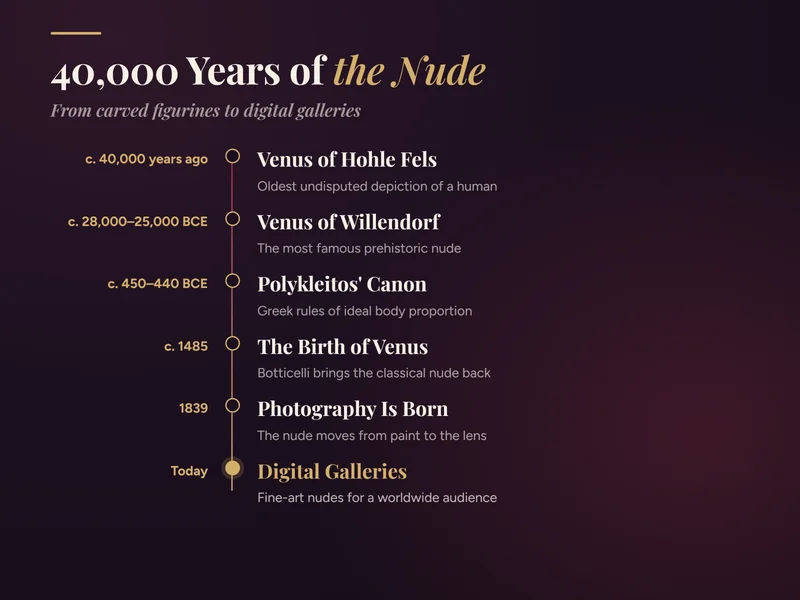
The fascination with the nude form is one of the most enduring constants in all of culture. From prehistoric figures carved tens of thousands of years ago to classical sculpture to Renaissance painting to erotic art and nude models at Erotic Beauties, people have been creating and appreciating depictions of the nude body for as long as art itself has existed.
But why is this the case? What is it about the nude that exerts such a powerful and lasting pull on us across every culture and every era of human history? The answer lies in a mix of psychology, biology, aesthetics, and culture, and understanding it reveals a great deal about human nature itself.
The Deep Roots Of A Universal Fascination
The appeal of the nude form is ancient. It appears to be close to universal across human cultures. During the earliest periods of human cultural expression, the body was one of the most natural and immediate subjects available to artists, and it has remained as such ever since. The fact that we find depictions of the nude form in nearly every culture and historical period, often produced by societies that had no contact with one another, strongly suggests that the fascination is not purely a product of a specific culture or era, but something that is rooted deeply in human nature itself.
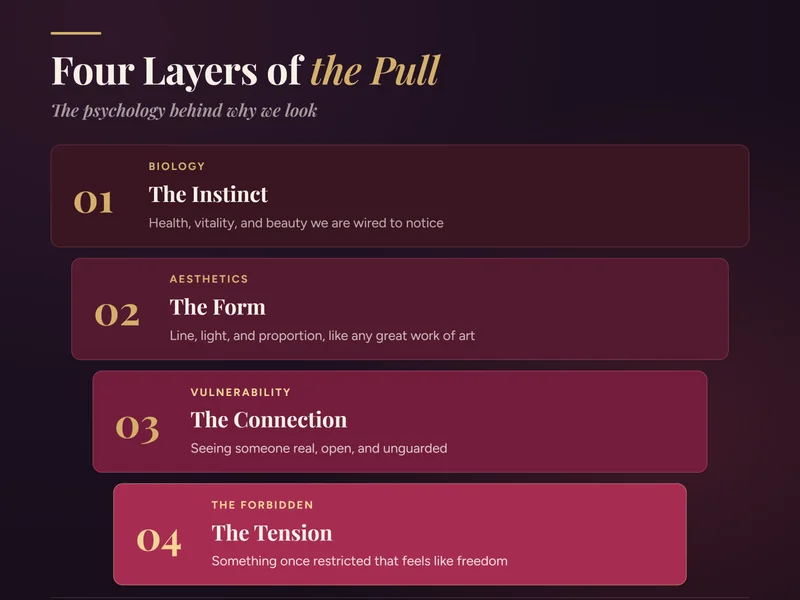
Part of this is biological, as the human attraction to the body is wired into us at a fundamental level. It is connected to the most basic drives of our species, including reproduction, recognition of health, vitality, and beauty in others. These instincts are ancient and powerful, and they form part of the foundation of our response to the nude.
But, to reduce the appeal of erotic art to mere biological impulse would miss most of what makes it interesting, because the human response to nudes engages far more than an instinct. If biology were the whole story, we would respond to all nudity equally, which is not the case. We can often distinguish, instinctively, between vulgar and beautiful nudity, as well as unnecessary and meaningful nudity, and this capability shows that there is something far beyond instincts alone.
Beauty, Form, And Aesthetic Pleasure
A significant part of the appeal of the nude in art is purely aesthetic. The human body, with its curves, lines, and proportions, is one of the most compositionally rich subjects an artist can work with. The same appreciation for harmony, balance, and beauty that draws us to a stunning landscape, an elegant building, or a piece of music also draws us to the well-composed nude. We respond to the play of light across skin, the elegant line of a pose, and the balance of a composition in the same way that we respond to beauty in any other form.
The Greeks developed entire systems of ideal proportion based on the human form, seeing in it a reflection of cosmic order and mathematical beauty. The pleasure we take in a beautifully composed nude photograph is the same pleasure we take in any beautiful work of art, which is the deep satisfaction of seeing form, light, and composition come together to create something mesmerizing. This is why the technical craft of nude photography matters so much, and why a skillfully made photo affects us so differently from one that has been made on a whim without any planning.
Vulnerability, Intimacy, And Connection
Beyond aesthetics, nudes carry a powerful psychological charge connected to vulnerability and intimacy. To be nude is to be exposed, open, unguarded, and depictions of the nude tap into deep feelings about intimacy and human connection. There is something profoundly affecting about the sense of seeing another person without the protective layer of clothing that we all use to present ourselves to the world. A great nude image can convey a sense of real vulnerability and authenticity that an image where someone is wearing clothes can rarely achieve.
This is why the presence of the model matters so much in nude photography, and why work that captures genuine vulnerability resonates deeper than work that feels staged. The viewer responds not just to the body itself, but to the sense of seeing something real, something unguarded that connects to the human desire for intimacy and connection.
In a world where so much of what we see is curated, edited, and performed, the real vulnerability of a great nude image offers something that is becoming rarer by the day, and that is the sense of real human presence. This emotional dimension, the feeling of connection and shared humanity, is one of the most important elements of erotic art, and why it moves us in ways that are far beyond the physical response.
The Allure Of The Forbidden And The Free
One part of the psychological appeal of erotic art is connected to the relationship with social taboos. For a decent part of history, the nude has been quite controversial, as it often went from something that is highly praised to something that was perceived as provocative or dangerous. This creates a special kind of tension that contributes to the appeal, because even if it was historically restricted, it also offers a kind of freedom. The combination of something slightly forbidden and liberating is what makes the genre endure through time, as it satisfies both our attraction to what is restricted and our desire for openness and honesty about the body.
An Enduring Human Impulse
The psychology behind our attraction to erotic art is rich, with many layers. It combines biological drives, aesthetic pleasure, emotional resonance, and cultural complexity into something far more interesting than can be captured in a single explanation. This is why the nude has remained a central subject from the first carved figurines to the latest digital photography, and why it continues to grab our attention today. Platforms like Erotic Beauties tap into this deep and ever-lasting human impulse, honoring the timeless fascination with the human form that has driven artists and viewers alike for as long as art has existed.